*Photo: The late Brigadier-General Benjamin Adekunle*
I was born in Kaduna on the 26th of June I936, the fifth in a line of six children born by Amina Theodora to a polygamous husband, Thomas Adekunle. My father, a native of Ogbomoso, was domiciled in Kaduna as early as 1908. He had met my mother in her hometown Numan, during one of his sojourns to the Adamawa Province and married her in 1919. She was a member of the Bachama Tribe, an ethnic group noted for their fighting abilities. As one of the earliest converts to Christianity in her area, my mother was a staunch Christian. She succeeded in converting my father Thomas to Christianity in the course of their courtship and we were raised as Anglicans.
According to the legend repeatedly narrated to me by elderly female relations during my childhood, the circumstances surrounding my early entry into the world were somewhat portentous. They said I overstayed my time in my mother’s womb by two months. Moreover, I am reported to have vacated this comfortable abode only after a series of local birth attendants had exhausted their entire repertoire of childbirth skills. These tales meant little to me at the time, but their chief significance was the special attention it secured for me from my family, particularly from my mother.
Both my father and grandfather served in the colonial army. My father later entered the carpentry trade where he made a sufficiently good living to fend for his large family of two wives (he later married a second wife, Christianity non-withstanding), a dozen children and numerous relatives. We all lived in the sprawling house that he built in the Kaduna Township.
By 1945, at age nine, I had enough of both school and my unsatisfactory home life. The death of my father in this year strengthened my resolve to take matters into my own hands. I resolved to leave home and look for someone to serve, in exchange for educational support. On the chosen night, I gathered my few belongings and ran away from my brother’s home. After several days on the streets, I found my way to one Reverend Ayiogu whom I persuaded to employ me as a domestic servant at the rate of one Shilling and six pence a month. With the assistance of the police, my elder brother soon traced me to my new living quarters. However, all entreaties, commands, cajolery and threats directed at me by the police officers, relations, and the Reverend to return with my brother fell on deaf ears; with Reverend Ayiogu I would remain or vanish again.
From this period, the influences to which I was exposed were more stabilizing. The Reverend proved to be a decent man and I lived with him for two years. By 1947, I came under the protection of a new Master. Under his guidance, I earned a scholarship to Dekina Primary School in Kwara State. My new Master was an extraordinary man though unimposing in appearance. In all the years I spent in the home of Mr. Quinni, a native of Ugep and employee of the Igala Native Authority, he never once raised his voice in anger. He was scrupulously just in his dealings with all persons around him. He was gifted with a formidable intellect, which was brought to bear in every situation. I was fascinated by his ability to win any argument by rigorous analysis. By the time he reached his conclusion, the parties present had little option but to agree, regardless of their own initial positions or whether his conclusion, conflicted with their own interests. It was for this reason that his polygamous home was calm, stable, and peaceful. Mr. Quinni taught me the strength in meekness, the honour in humility, and the dignity in labor. If I have not always succeeded in exhibiting these qualities, he blessed me with the ability to appreciate and esteem them in others.
Under his influence, I thrived at my new school (Dekina Primary School) to the extent that my progress caught the attention of the Head Master, Mr. Dokpong. Among my schoolmates at Dekina was the one time Director of the Nigerian Twelve Corps Service, Colonel Ahmadu Ali, who is still a friend. I passed the entrance examination to Okene Middle School in 1951and left Dekina with many happy memories.
After my primary education, my relatives in Idah attempted to reassert their claims over me. According to their plans, I was to stop my schooling and be apprenticed in the family trade of carpentry. Needless to say, I vehemently resisted this plan as my years with Mr. Quinni had the effect of drilling in me, a powerful thirst and respect for western education. My stubbornness on this point served to severe all pretense of supervision over my welfare by my guardians. It was now clear to all that I was on my own. I was given to understand that I should expect no support from them. I steeled my mind to fend for myself, to plough a lonely furrow and take life as it came. Fortunately, for me those were the days of free education.
To Okene Middle School I went. I met other interesting characters such as Mr. Bolujoko whom we had nicknamed ‘the black horse of Okene Rock.’ Though an almost fanatical disciplinarian, Mr. Bolujoko like my former Master, possessed the ability to inspire the best in anyone and nurture the person’s more positive qualities. Despotic though he was, he personified to his students the modernized and educated man. In addition to academic development, Mr. Bolujoko took great interest in the spiritual development of his students.
My Military Career
I enlisted in tile Nigerian Army in 1957 immediately after I finished my school certificate examination. The idea of beginning ‘life’ at once, without the suspense and irritating interlude of University strongly appealed to me, a young man without the luxurious backdrop of a solicitous family. Large or small, I had already proved my physical mettle on a thousand occasions; why not I reasoned, fight for a worthy cause – in the service of my fatherland? With the images of the confident giants of 1945 in my head, I departed for Lagos after my final examination and found my way to the Apapa cantonment.
The first hurdle in my chosen career was the stiff entrance examination. At the succeeding interview, numerous white-headed expatriate military officers gave me the grilling of my life. The Nigerian army was then in its infancy and placed every conceivable impediment to dissuade aspirants from making the army a career. These obstacles did not daunt me. We were then made to undergo physical exercises. I found these exercises hilarious. I was given size 12 boots (I take a size 6); and oversized clothing. For a joke, I put them on and appeared at the venue to the vast amusement of the other boys. Notwithstanding my deficiency in size, the Army accepted me.
Reflecting on Africa’s propensity for coups in the post-independence era, I sometimes felt that it could be traced to some extent, to the feelings of indispensability that was nurtured in cadets at this stage of our training. Time without number, the importance of our roles in shaping the future of our nations was impressed on the minds of young military officers. This was not done with any sinister motive, but certainly, the orientation we were given was capable of sowing seeds of the ‘messiah complex’ in some of the cadets that passed through the institution. Also of some significance I believe, were subconscious feelings of competitiveness among the officers. If former course mates could successfully execute a coup in their countries, who wanted to be caught lagging? On January 15, 1966, Nzeogwu implemented his coup. In my opinion, there was a domino effect on the rest of Africa following the one in Nigeria.
The day of reckoning, which separated the boys from the men soon arrived. Though I had immersed myself in the world of the institution and had given my all, I was as nervous as hell. I had never before failed any task I set out to achieve, but there was no telling what the results of this selection board would be. The waiting period was a period of severe anxiety for me. To my profound relief, I passed this selection and the board recommended me for Royal Military Academy at Sandhurst, England (RMAS). We (the successful cadets) went wild with joy. For the rest of our stay at Teshie, we conducted ourselves with licentiousness that would have been unthinkable only a few weeks before.
Britain
Prior to Sandhurst, cadets were sent to Mons Officer Cadet School in the UK for a period of three months. The objective of the Mons training was to separate cadets for either a long or a short training course. The older cadets were sent on the short course, while the younger or more able cadets were sent to Sandhurst. The Mons training was to be my first experience outside my native country and nothing in my interactions with expatriates in Africa prepared me for the culture shock I experienced in those first few months in Britain.
The first shock was the freezing cold. However, this was a condition that I could and did adapt to. What was harder to adapt to was the overt and covert racism that infected the entire British society. There are several facets of racism: first, the conviction that blacks were innately inferior to whites and secondly, an intolerance for blacks who failed to conform to a restricted number of stereotypes. From my observations, there were two acceptable ‘African Types’; the ‘funny’ African who grinned incessantly and was incapable of taking offense and secondly, the ‘ignorant’ African, who understood nothing, appreciated his own ignorance, and was profoundly grateful for whatever attention was bestowed on him by the all knowing Whites.
The examination period arrived and again, I was filled with anxiety about my chances of success given the sour relationship between the instructors and myself. Other Nigerian officers who were contemporaries at Mons were Chukuka, Idiaja, Nnadi, Obasanjo and Adegoke.
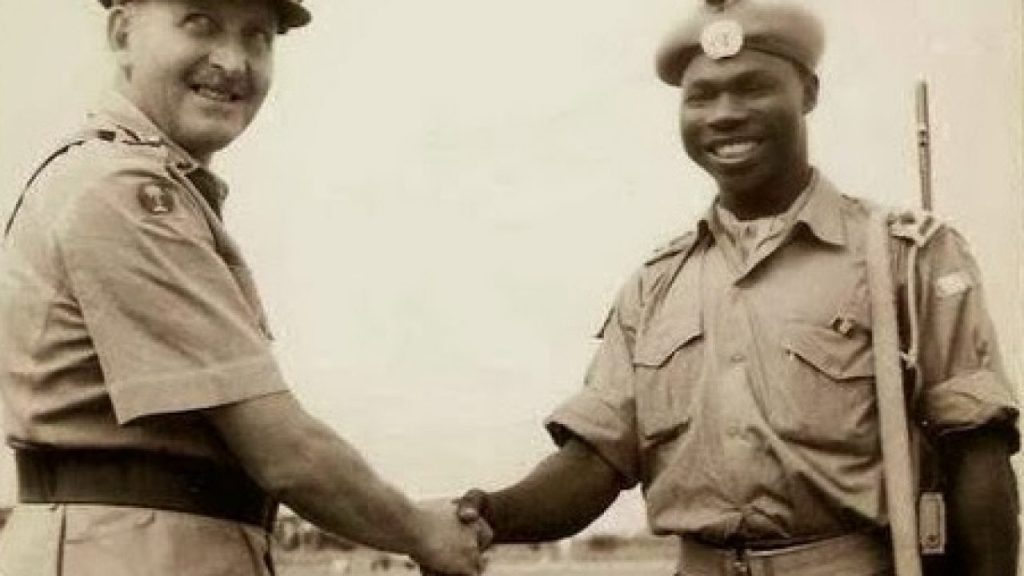
*Photo R-L: Chief (General) Olusegun Obasanjo as a junior military officer with a British military instructor *
Once again, my fears promise to be unfounded. I passed the Mons examination and was confirmed for Sandhurst in January of 1959.
I considered my selection for the Royal Military Academy Sandhurst to be an honour and a privilege. To my mind, Sandhurst was the best military institution in the World. Not all the Mons graduates were so privileged – for example, while Adegoke, Idiaja, and Chakuka and I was selected, Obasanjo was not. He finished at Mons and returned home.
In later years, I attributed some of the actions of my former course mates in the national arena, especially with regard to their colleagues, to the need to assuage feelings of inferiority which many have sprung from having been publicly adjudged and labeled inadequate in the midst of their cohorts.
I was at Sandhurst for two years (1959 and 1961) and registered for the course with three hundred odd cadets. In addition to the physical training, officers where imbued with a thorough academic grounding in the art of warfare. The ultimate purpose of our training was to produce not the stereotype officer, but the dynamic officer. Character development was an integral part of the course and this was brought home to me in the first week.
Before I left Sandhurst, our College Commander invited me for an interview. He examined me closely about my ‘unorthodox’ political positions, my views on his institution, and my opinions of the training that I had just completed. In our final report, Sandhurst cadets were required to make a self-assessment of their officer qualities, which was then graded by their instructor. My final report and grade contained some of the two familiar complaints about my ‘attitude’. Since the report had already been written (and passed me, notwithstanding) I felt at liberty to give the Commander an unedited piece of my mind on every subject he raised.
Far from being satisfied with my responses and desirous I think, of modifying my views, he suggested an extension of the ‘interview’ over dinner. We talked far into the night, and I conveyed my amazement that an institution would teach a course which mutilated the pride and self worth of some of the cadets and yet expect no reaction.
On the whole however, I enjoyed the period at Sandburst. The skills I picked up, particularly on the ‘Tactics’ course, (my favorite ), were to prove invaluable to me in later life.
My encounter with British military institutions did not end there. Two further courses were arranged for me in accordance with my selection. The first was at the School of Infantry at Warminster, and the second was at the School of the Tactical Wing. And so ended my military training in Britain.
My first unit was the first Queen’s Own Nigerian Regiment based in Enugu. At this time, a good number of the senior officers were British, though there was a sprinkling of Nigerian officers and one Cameroonian, (Captain Malinga), whose awe of the British officers was a source of constant amusement.
Regimental life lived entirely up to my expectations. I was appointed the platoon commander of ‘C’ Company under the command of then Major Ogundipe. My main duty was to assist in training the troops. They were a mixed breed but those of Bachama extraction, (my mother’s ethnic group), impressed me more than the others. There were quite a number of them in my platoon.
After a few months, we were posted to thc Republic of the Congo en masse, under the auspices of the United Nations, to quell the growing unrest there. The antecedents of the political turmoil in the Republic of Congo as is in much of Africa, could be traced to its colonial period. Congo was a colony of Belgium and its capital Leopoldville (now Kinshasa) was named after Leopold II of Belgium. The Congo was rich with precious minerals such as diamonds. Uranium was abundant in the Congo-in fact, the first atomic weapons were developed with uranium from the Congo.
The burning crisis for which troops were posted to the Congo involved the power struggles between the old colonial powers, Congolese nationalists and later, Congolese stooges of the Colonial powers. Municipal elections had already taken place in 1957; nationalists organized pre-independence elections after serious agitation in January 1959. Patrice Lumumba’s Congolese National Movement emerged as the winner of the May 1960 elections. Lumumba became Prime Minister and on June 30, 1960 the Independent Republic of Congo was proclaimed. Violence within the Congo intensified soon after independence, and the political situation was complicated by the attempted secession of the mineral- rich province of Katanga in July. The Katangan Premier was funded and supported by Belgium. Lumumba invited the United Nations into the conflict and the UN demanded the withdrawal of Belgian forces from the country. Peacekeeping forces were then sent into the Congo with a mandate to restore order to the Congo and the Katangan province. Patrice Lumumba was murdered in the subsequent violence (January 1961) and UN peacekeepers were mandated to use force to prevent civil war. In spite of the spirited efforts of the UN Secretarial-General, Hammarskjold (who lost his life in a suspicious plane crash during one his Congo peace trips), the violence continued unabated. Mobuto Sese Seko, then the head of the army, foisted himself on the country as President in November 1965, according to him, for a 5-year term in October 1966. He formally dismissed the Parliament and the new Prime Minister and established a Presidential form of government. The ‘five year term’ ran over three decades.
Congo was a profoundly beautiful country though completely underdeveloped in physical terms. We were stationed in Leopoldville. Our first assignment was to fish out the murderers of about 15 Nigerians, who had been mutilated after their murder. It was hard going in that environment with very few roads, non-existent telecommunications system, and a perplexing language. With some hard work and the assistance of our intelligence system, the perpetrators were identified, tracked down and appropriately punished.
The language barrier precluded extensive interactions with the Congolese people, but my overriding impression of their lives, was of intense suffering. The amenities of life- electricity, clean water, roads, hospitals, etc- were in very scarce supply and the level of hunger, disease, immorality, physical insecurity and crime in the society as a whole was pitiful. As far as I was concerned, Nigerians were incomparably better off. I was also struck by the rigidity of the informal ‘apartheid’ system prevalent in Congo: after my experiences in the U.K, I had grown to be somewhat hypersensitive and intolerant of all forms of racism. I noticed that unlike Nigeria, the two races were almost completely estranged – not only physically segregated, but with few avenues for interaction, such as sporting or social events, where the differences of skin color were temporarily forgotten.
I watched the naughty bearing of the Congolese expatriates towards the owners of the land and their total subservience. The only relief available to the Congolese from the misery and deprivations they suffered appeared to be drinking, music and dancing. I would watch for hours as the Congolese men and women cast aside their cares and abandoned themselves to ‘Congo music.’
Just as I settled down to learn more about my environment in the Congo, I was bundled home to Enugu to become the first Army officer Aide-de-camp to Sir Francis Akanu Ibiam, the first Governor of the Eastern Region.
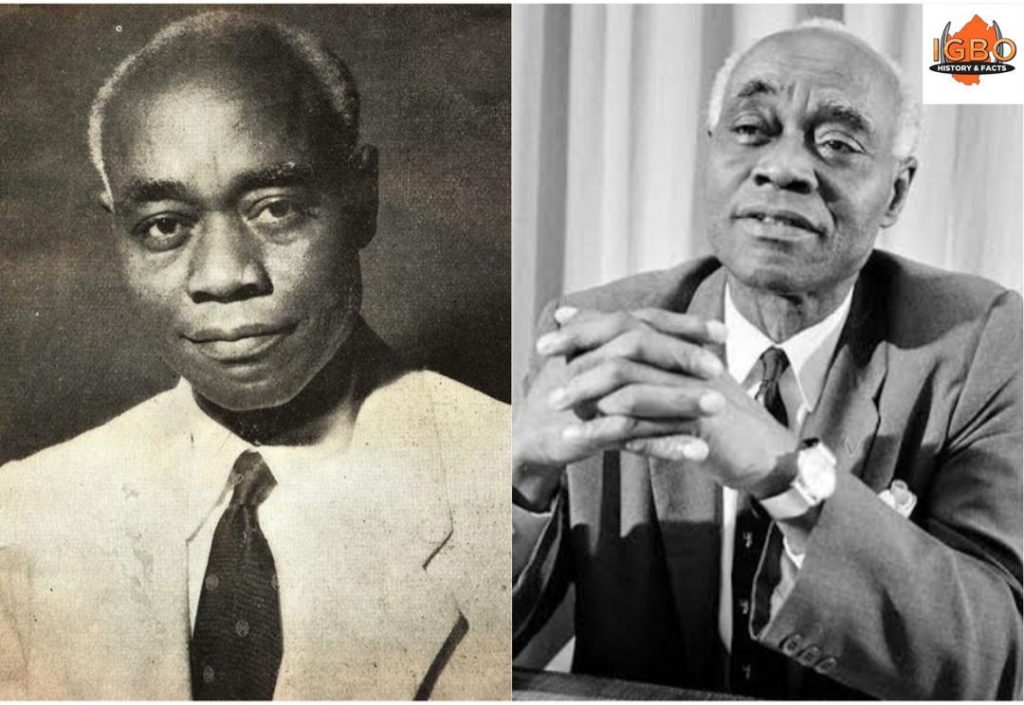
*Sir Francis Akanu Ibiam*
Sir Francis Ibiam was a well respected Nigerian politician. An old boy of King’s College and a graduate of the University of St. Andrews in Scotland, he received a knighthood from the Queen in recognition of his accomplishments. He built Abiriba hospital, and served on several hospital boards. He had served on the Nigerian Legislative Council, between 1947 and 1952, on the Executive and Privy Councils between 1949 and 1959 and capped this with his appointment as Governor of Eastern Nigeria from 1960 to 1966. Sir Ibiam also chaired several Church Councils, including the World Council of Churches in 1961.
Within a very short period, it became clear that we had ‘irreconcilable differences.’ The nature of my posting compelled me to spend a lot of time with the governor, and at very close quarters. I was with Dr. Ibiam on formal occasions, I was with him behind the scenes at his home, and I witnessed and contributed to the policy-making processes of the Eastern regional government on a day-to-day basis at the office.
In many ways, Dr. Ibiam was a gentleman. However, there were several difficulties I had will the governor. The first was what I regarded as his religious rigidity. Like many persons I had come across, Dr. Ibiam was passionate almost to the point of fanaticism about matters of external religious observance – church going, prayers before meals etc.
Secondly, the good Doctor’s treatment of his staff caused me to mull over the contradictions between what is preached as opposed to practice. I failed to understand why the Governor seemed unable to appreciate the connection between welfare, morale and productivity. Consequently, the working environment at the Governors office left much to be desired, characterized as it was by surliness, complaints and resentment. Our relationship was not improved by my blunt rejection of his attempts to compel me to conform to his religious practices.
The most serious chasm concerned our professional duties. As the governor of a region, which embraced many different ethnic groups, my boss appeared to have some difficulty in appreciating that he owed each inhabitant of the region an equal obligation. It seemed to me that at every turn of policy- making, he favored members of his own tribal group.
As a Nigerian of multi-ethnic parentage, born and raised outside my region of ‘origin,’ I found these exhibitions of ethnic chauvinism incomprehensible.