The Independent National Electoral Commission (INEC) has explained why it rejected some petitions seeking the inclusion or removal of individuals from the final lists of candidates for the governorship and State Houses of Assembly elections.
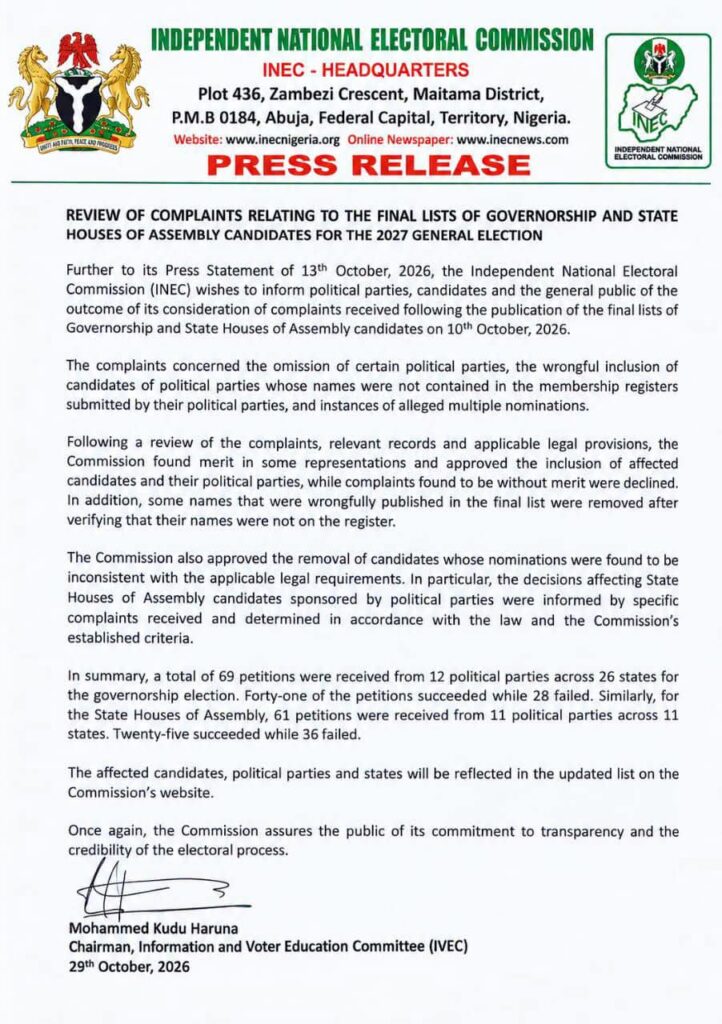
The Commission said it reviewed complaints submitted by political parties and other concerned parties following the publication of the final lists of candidates on October 10, 2026, and approved changes where the petitions were found to have merit under the applicable laws and electoral guidelines.
INEC disclosed that it received 69 petitions from 12 political parties across 26 states in respect of the governorship elections. Of these, 41 were successful, while 28 were rejected.
For the State Houses of Assembly elections, the Commission received 61 petitions from 11 political parties across 11 states. Twenty-five petitions succeeded, while 36 were declined.
The figures were contained in a press statement issued on Thursday, October 29, by Mohammed Kudu Haruna, Chairman of INEC’s Information and Voter Education Committee (IVEC).
According to the Commission, the complaints centred on the omission of some political parties from the published lists, the inclusion of candidates whose names did not appear in their parties’ membership registers submitted to INEC, and allegations of multiple nominations.
The Commission said it examined the petitions alongside relevant records and applicable legal provisions before reaching its decisions.
It explained that petitions found to be meritorious resulted in the inclusion of affected candidates and political parties, while those that failed to meet the required legal and evidential standards were rejected.
INEC also confirmed that it removed some candidates whose names had been wrongfully published after verification established that they were not listed in the membership registers submitted by their political parties.
In addition, the Commission approved the removal of candidates whose nominations were found to be inconsistent with applicable legal requirements.
The electoral umpire particularly noted that decisions affecting candidates for State Houses of Assembly sponsored by political parties were based on specific complaints received and determined in line with the law and the Commission’s established criteria.
The latest clarification followed an earlier press statement issued by INEC on October 13, 2026, concerning complaints arising from the publication of the final lists of candidates for the governorship and State Houses of Assembly elections.
Although the Commission did not identify all the affected candidates and political parties in the statement, it said the names of the candidates and parties concerned, as well as the states affected by the decisions, would be reflected in an updated list to be published on its website.
The review underscores the importance of compliance with electoral requirements governing party membership, candidate nomination and the submission of valid records to the Commission.
INEC reiterated its commitment to transparency and the credibility of the electoral process, assuring political parties, candidates and the general public that complaints would continue to be handled in accordance with the law.
The Commission’s decisions are expected to provide further clarity on the final lists of candidates ahead of the forthcoming governorship and State Houses of Assembly elections.