*Governor Babajide Sanwo-Olu
Lagos State Governor, Babajide Olusola Sanwo-Olu, has declared that the era when the ruling party could rely on “federal might” to influence election outcomes in Nigeria is over.
Sanwo-Olu made the assertion on Thursday while delivering a lecture titled “2027 Elections: Economy, Security and Nigeria’s Future” at the Freedom Online 7th Yearly Lecture held at the Sheraton Lagos Hotel, Ikeja.
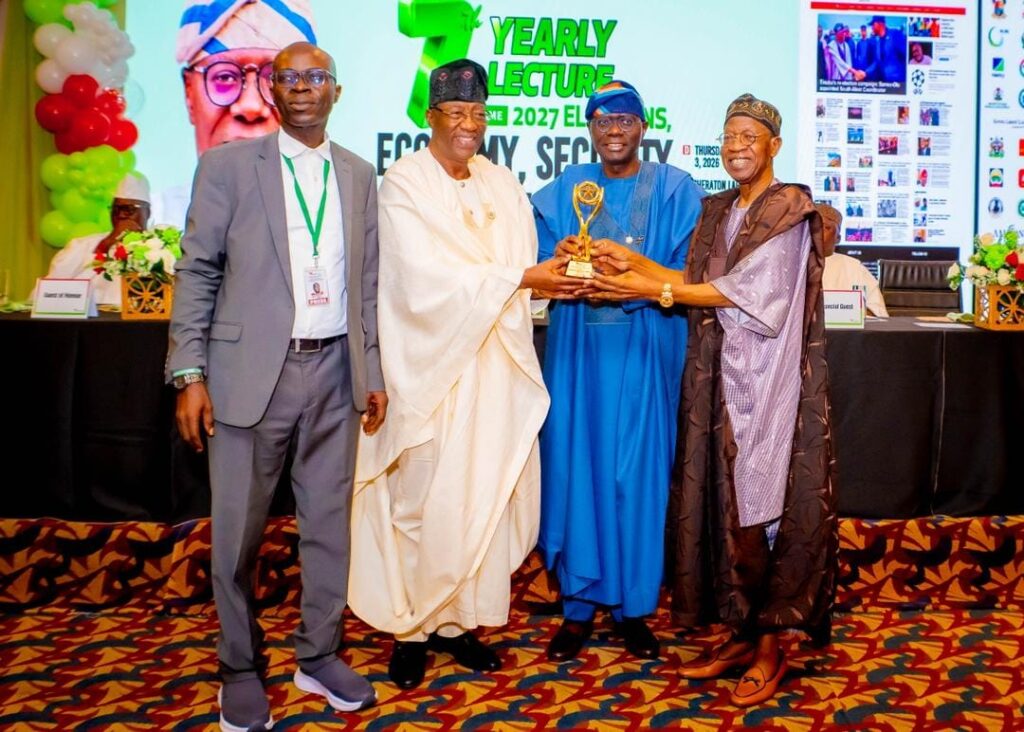
*L-R: Mr Gabriel Akinadewo, Publisher, Freedom Online: Senator Gbenga Daniel, Governor Sanwo-Olu and Alhaji Lai Mohammed, former Minister of Information and Culture, at the Freedom Online 7th Yearly Lecture.
The governor cited the recent Osun State governorship election as evidence that the Federal Government under President Bola Ahmed Tinubu was committed to allowing Nigerians to freely determine their leaders at the polls.
According to him, the candidate of the ruling All Progressives Congress (APC) lost the August 15 governorship election in Osun State to incumbent Governor Ademola Adeleke of another political party.
He said rather than interfere with the outcome, President Tinubu congratulated Adeleke the following day and thanked the Independent National Electoral Commission (INEC) and security agencies for conducting a peaceful election.
“Think about what that means. There was a time in this country when ‘federal might’ was a phrase that a ruling party used without irony.
“Under this President, the ruling party can lose a state, in the South-West, in an election year, and the sky does not fall. That is what a maturing democracy looks like,” Sanwo-Olu said.
He added that Adeleke had publicly thanked the President for ensuring a level playing field during the election.
Sanwo-Olu, who described himself as a technocrat, politician and governor serving the final months of his second and last term, said his position gave him the freedom to speak frankly about the 2027 elections.
He said the forthcoming general election would be the eighth consecutive general election since the return to democratic rule in 1999, describing Nigeria’s uninterrupted electoral process as an achievement that must be protected.
The governor warned that the credibility of the 2027 elections would be as important as the issues of the economy and security, urging INEC and security agencies to begin preparations early for possible threats to the electoral process.
He also defended the economic reforms of the Tinubu administration, particularly the removal of fuel subsidy, saying the policy had caused hardship but was necessary to prevent public resources from being drained through an unsustainable subsidy regime.
Sanwo-Olu said recent economic indicators showed signs of recovery, citing the National Bureau of Statistics’ second-quarter 2026 GDP growth figure of 4.43 per cent, increased foreign reserves and rising remittances.
“These are not my numbers. They belong to the National Bureau of Statistics and the Central Bank of Nigeria, and every journalist in this hall can check them,” he said.
The governor said the APC intended to continue with the reforms while ensuring that their benefits reached Nigerians who had borne the initial cost.
On security, Sanwo-Olu highlighted the expansion of the Nigerian Army, establishment of new security structures and increased collaboration with international partners.
He also strongly advocated State Policing, drawing from Lagos State’s experience with community-based security initiatives and the Lagos State Security Trust Fund.
According to him, security is most effective when communities can see and hold accountable those responsible for protecting them.
“Security works best when the people who pay for it and the people who depend on it can see, and hold to account, the people who provide it,” he said.
Sanwo-Olu further linked insecurity to economic hardship, arguing that poverty and insecurity reinforce each other.
“When a farmer cannot go to his farm, the nation gets hungrier. When a school is not safe, the country gets another cohort of children who never learned to read,” he said.
He also urged Nigerians to judge governors and other political leaders by their records, saying voters were capable of assessing whether governments had delivered on their promises.
“Voters may not be economists, but they are excellent accountants. They know whether their State built the road it promised. They know whether the primary health centre has a nurse in it. They will bring that ledger with them to the polling unit,” he said.
The governor called on the media to play a rigorous role in the 2027 electoral process by fact-checking politicians, exposing disinformation and scrutinising all political parties, including his own.
He urged journalists to pay greater attention to women and young people seeking elective office, while also reporting positive developments across the country.
Sanwo-Olu, however, made no secret of his political preference, saying he expected the APC to win the 2027 election and President Tinubu to secure a second term.
“I will not disguise my hope for the outcome. I expect my party to win, and I expect a second term for President Tinubu to consolidate the Renewed Hope agenda, because an unfinished reform is the most expensive kind,” he said.
He nevertheless expressed confidence that the election would be peaceful and that the loser would concede.
Sanwo-Olu said Nigeria’s future should not be defined merely by surviving the 2027 election, but by using the opportunity to deepen democratic institutions, strengthen security, grow the economy and harness the country’s youthful population.
“Let 2027 be remembered not as the election Nigeria survived, but as the election at which Nigeria came of age,” he said.